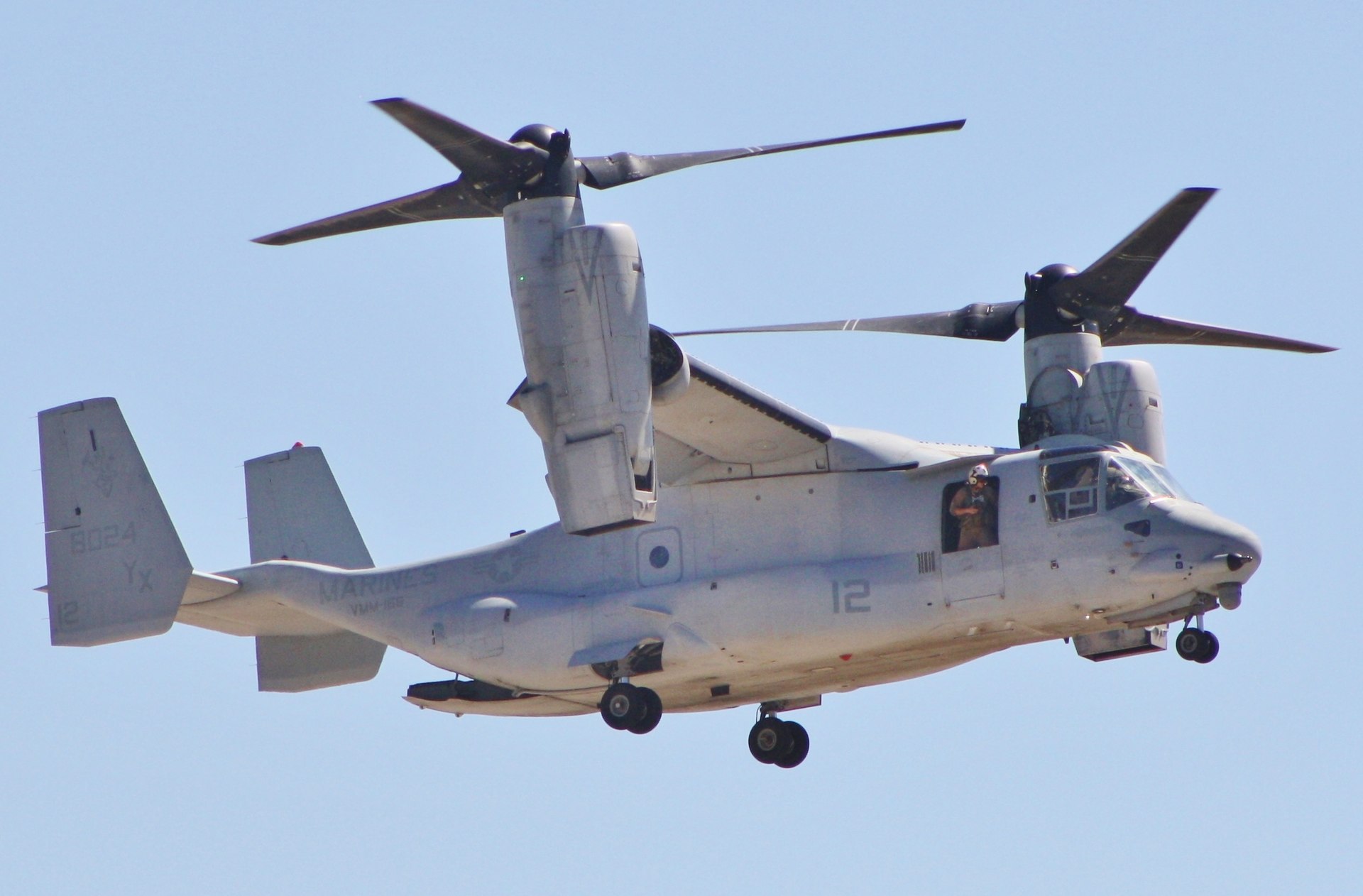
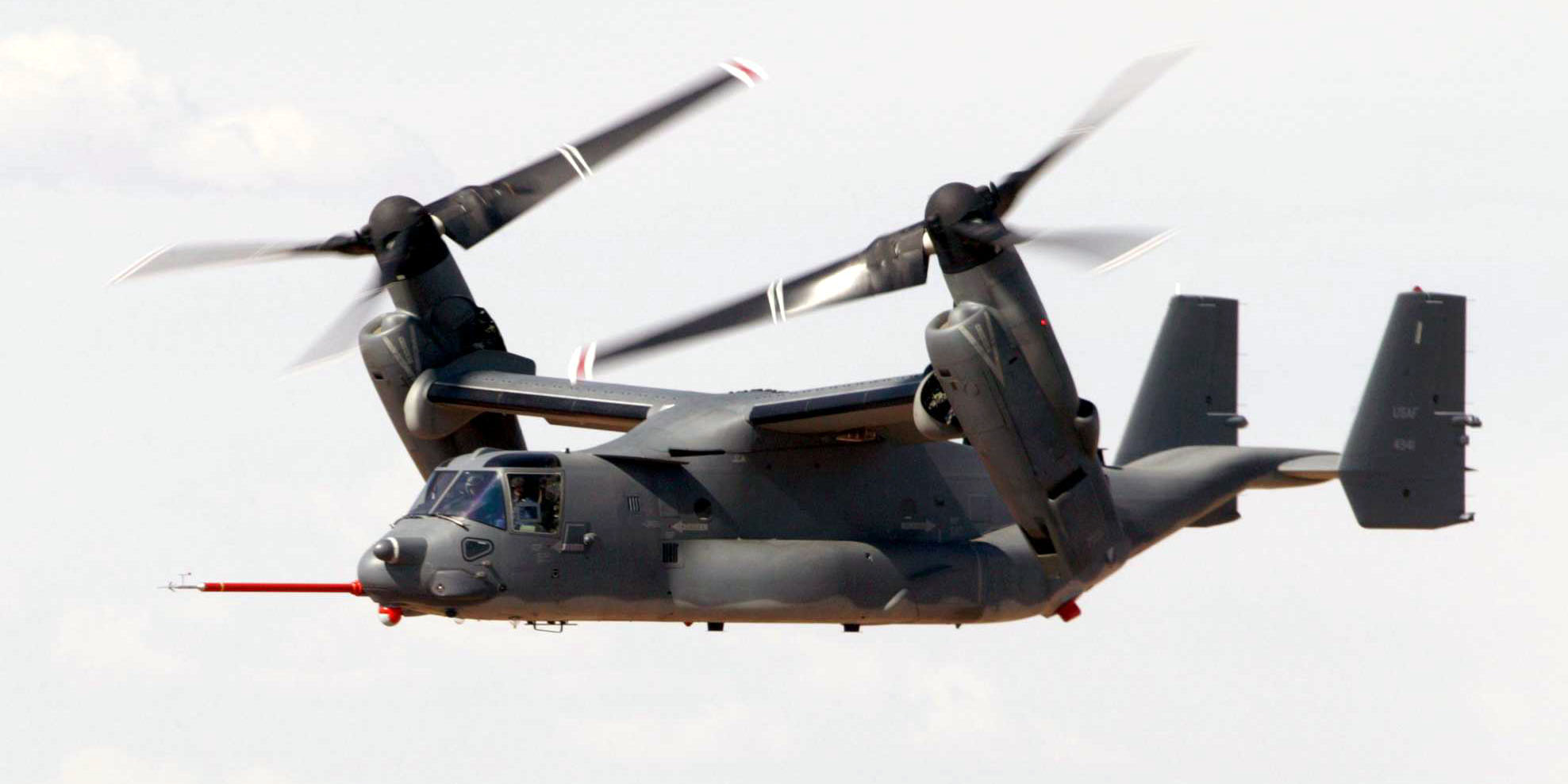
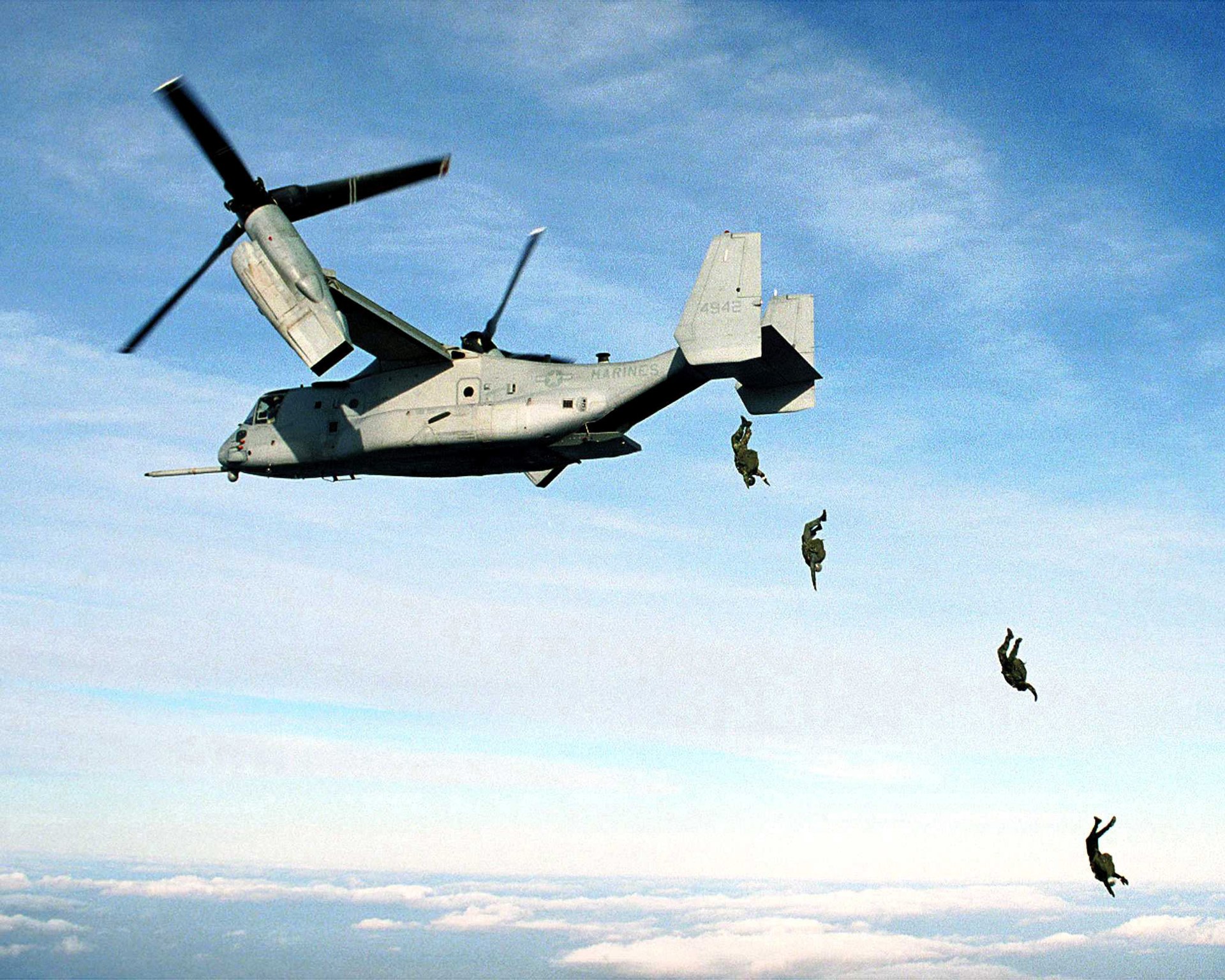
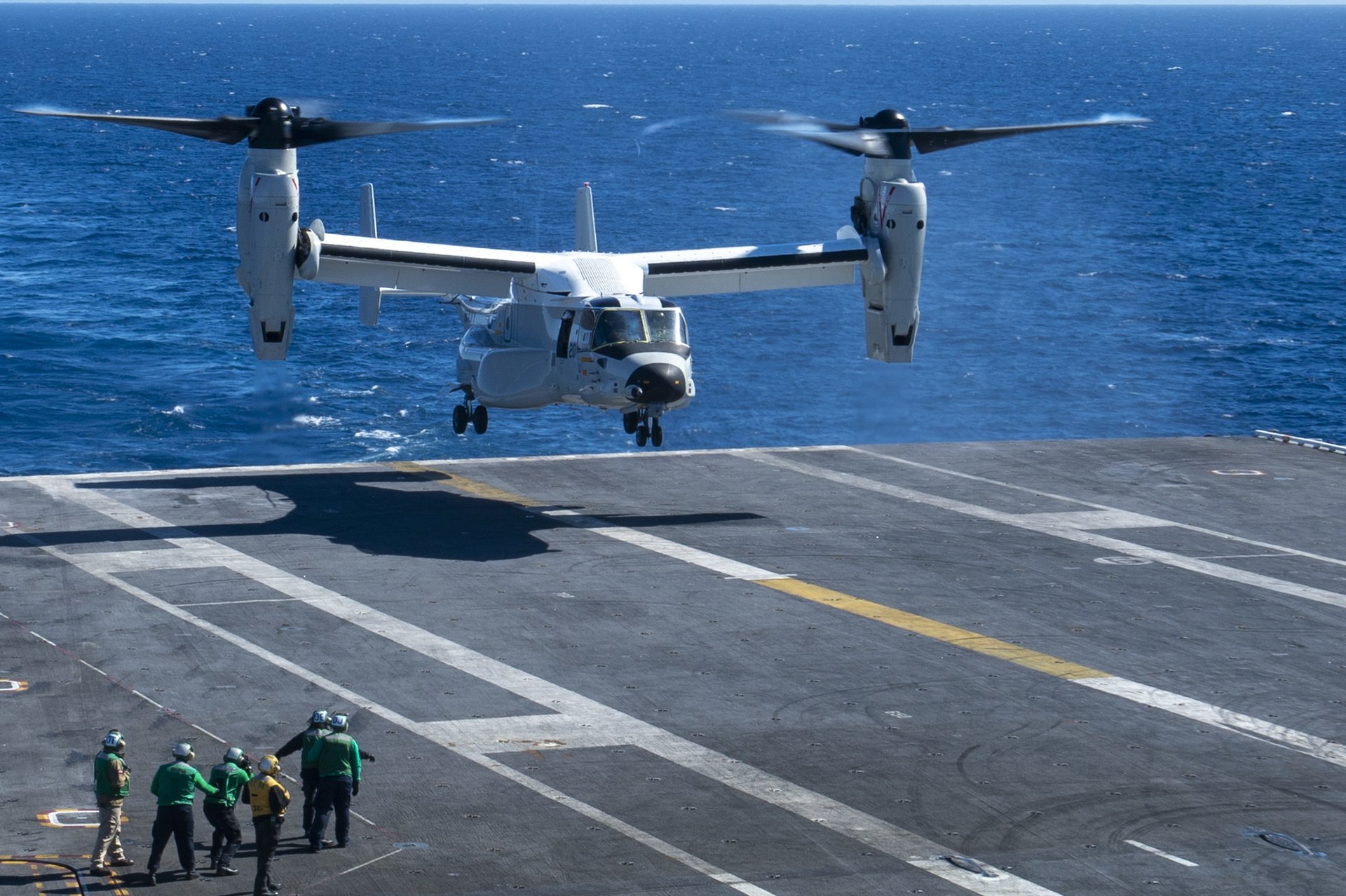
V-22 Osprey CHARACTERISTICS
Crew: 3–4 (pilot, copilot and 1 or 2 flight engineers/crew chiefs/loadmasters/gunners)
Capacity:
24 troops (seated), 32 troops (floor loaded), or
20,000 pounds (9,100 kg) of internal cargo, or up to 15,000 pounds (6,800 kg) of external cargo (dual hook)
1× M1161 Growler light internally transportable ground vehicle[298][299]
Length: 57 ft 4 in (17.48 m) Length folded: 62 ft 7.6 in (19.091 m)
Wingspan: 45 ft 10 in (13.97 m)
Width: 84 ft 6.8 in (25.776 m) including rotors
Width folded: 18 ft 5 in (5.61 m)
Height: 22 ft 1 in (6.73 m) engine nacelles vertical;
17 ft 7.8 in (5 m) to top of tailfins
Height folded: 18 ft 1 in (5.51 m)
Wing area: 301.4 sq ft (28.00 m2)
Empty weight: 31,818 lb (14,432 kg)
Operating weight, empty: 32,623 lb (14,798 kg)
Gross weight: 39,500 lb (17,917 kg)
Combat weight: 42,712 lb (19,374 kg)
Maximum take-off weight VTO: 47,500 lb (21,546 kg)
Maximum take-off weight STO: 55,000 lb (24,948 kg)
Maximum take-off weight STO, ferry: 60,500 lb (27,442 kg)
Fuel capacity: Ferry maximum: 4,451 US gal (3,706 imp gal; 16,850 L) of JP-4 / JP-5 / JP-8 to MIL-T-5624
Powerplant: 2 × Rolls-Royce T406-AD-400 turboprop/turboshaft engines, 6,150 hp (4,590 kW) each maximum at 15,000 rpm at sea level, 59 °F (15 °C)
5,890 hp (4,392 kW) maximum continuous at 15,000 rpm at sea level, 59 °F (15 °C)
Main rotor diameter: 2 × 38 ft (12 m)
Main rotor area: 2,268 sq ft (210.7 m2) 3-bladed
Performance
Maximum speed: 275 kn (316 mph, 509 km/h) [300]
305 kn (565 km/h; 351 mph) at 15,000 ft (4,600 m)[301]
Stall speed: 110 kn (130 mph, 200 km/h) [76]
Range: 879 nmi (1,012 mi, 1,628 km)
Combat range: 390 nmi (450 mi, 720 km)
Ferry range: 2,230 nmi (2,570 mi, 4,130 km)
Service ceiling: 25,000 ft (7,600 m)
g limits: +4 max / -1 min
Maximum glide ratio: 4.5:1[76]
Rate of climb: 2,320–4,000 ft/min (11.8–20.3 m/s) [76]
Wing loading: 20.9 lb/sq ft (102 kg/m2) at 47,500 lb (21,546 kg)
Power/mass: 0.259 hp/lb (0.426 kW/kg)
Armament
1 × 7.62 mm (.308 in) M240 machine gun or .50 in (12.7 mm) M2 Browning machine gun on ramp, removable
1 × 7.62 mm (.308 in) GAU-17 minigun, belly-mounted, retractable, video remote control in the Remote Guardian System [optional][135][302]
Avionics
AN/ARC-182 VHF/UHF radio
KY-58 VHF/UHF encryption
ANDVT HF encryption
AN/AAR-47 Missile Approach Warning System
AN/AYK-14 Mission Computers
APQ-168 Multifunction radar
Directional Infrared Counter Measures (DIRCM)[303]